Archived · Jazz and Beyond · Jazz · 17 min read
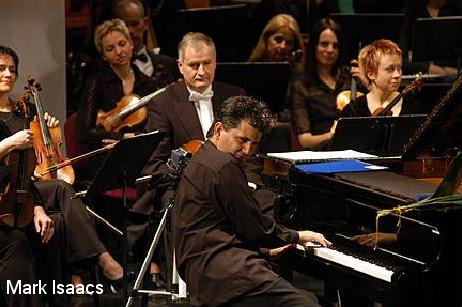
Frank Presley's interview with classical/jazz pianist/composer Mark Isaacs 12
Frank Presley's interview with classical/jazz pianist/composer Mark Isaacs 12 th June 2005 "I think people are less inclined to go out and hear live…
This date is the archive capture date; the original publication date was unavailable.
Historical article recovered from a Wayback capture dated 2018-02-24.
th
June 2005
“I think people are less inclined to go out and hear live music because they can simply pipe such good music into their own homes”
Frank Presley:
Describe what it was like growing up in such a highly musical family and experiencing people like Duke Ellington and Wes Montgomery?
Mark Isaacs:
Well it actually was my uncle’s home Ike Isaacs and that’s just a bit of a family legend. I didn’t directly experience that. I was just aware that it had happened. There were other famous musicians that came through. I remember a jam session with Joe Pass at one time and Martin Taylor the guitarist. Here in Australia, Don Burrows visited many times and my own family were very musical. My uncle Ike who I mentioned and my father a jazz guitarist. My mother played classical piano. It really was a very productive environment to be in for somebody who had musical aspirations as I discovered quite early that I did. I found I could really interact. I had another uncle who was a classical violinist and he put me through my paces many times and checked out what I was doing with classical music. So it was great. I think for somebody who has musical aspirations, it can be great, but it’s very interesting. I am asked this question quite often. The counter example is a superlative musician such as Leonard Bernstein who came from a completely non-musical family. So it’s not a prerequisite but it certainly does help.
FP:
Coming from such a broadly based and successful musical family, did you ever feel overwhelmed by the pressure to succeed?
MI:
No I’ve never felt overwhelmed by that pressure
FP:
What part of your career do you enjoy most performing, recording or composing?
MI:
It’s a good question and it’s hard to answer because I couldn’t really single out one. It’s all part of the one puzzle. I feel very blessed and grateful that I can express my music through various ways, through various means. For example, I find ‘composing’ is a very solitary pursuit and that has it’s advantages because when you compose, you really do enter a conceptual sound world where you’re imagining this piece in isolation that will eventually be performed of course. Well hopefully by other people. It’s a very sort of reaching out for some sort of visionary kind of thing as a single person, where as in performing and recording, largely these are ensemble-based operations. You have a wonderful joy of bouncing off other musicians and that is also very joyous but I wouldn’t say there are pluses and minuses in both. In some ways my introvert side is indulged as a composer but my extravert side is indulged as a performer because I am with people, maybe touring and seeing different parts of the world. So I wouldn’t be without either but I feel very lucky to have both. I put them all neck and neck.
FP:
Does composing music come easy to you?
MI:
Not always easy. It does sort of generally flow although I find as I get older I’m editing myself a lot more and perhaps when you have a backlog of compositions behind you, as one progresses through ones career, the challenge is to re-invent yourself and to be fresh and to make each piece alive. That seemed quite easy when I was young because the pieces would just flow but now there’s this sort of back catalogue hovering over on me and weighing on me. I am finding it sometimes harder to get started and I tend to throw away more material than I ever did. I never really did that [before]. Actually I used to just write it down almost like dictation when I was younger but now I might throw away four or five days work so in some ways it’s getting more difficult but it’s actually getting more rewarding because I think and I hope that I’m refining what I’m doing and the results are more mature. I do hope that I can keep the effervescence of youth in there as well.
FP:
How would you compare the challenge of re-arranging a jazz standard to suite your jazz trio to say composing a new jazz tune?
MI:
Well it’s still a very creative and challenging discipline. I don’t generally re-arrange in the sense of writing an arrangement. I tend to bring standards into a trio context and just call the tune. The re-arrangement takes place on the fly between the ways the players create it. It’s very much an improvised arrangement if you like. There’s a lot of talk about original Australian music say for example lately, I’ve been doing a lot of standards. I consider that just as much a creative part of what I do and I hope that the results themselves are also original. Because as a jazz player you really are using a standard song as a springboard or template to create something original. So I don’t see it as any less challenging.
FP:
Lets talk about your new band. What qualities are you looking for when you are looking to assemble a new trio?
MI:
Yes well I have been working with young players a lot especially in Australia I’ve been working for a couple of years now with Ben Waples the bass player who is only 23 years of age. Considerably younger than me. In fact 23 years younger than me. I am precisely double his age. Also I’ve bee playing for the last couple of years with a young drummer called Felix Bloxsom. On this occasion I’m playing with James Hauptman who is 22 and an emerging and wonderful drummer on the scene and whom I am very much enjoying working with. We’ve had a couple of rehearsals and they’ve gone very well. Regarding the repertoire. I’m extending the idea of my last CD which was called ‘Keeping the Standards’ an exploration of jazz standards. On this project I’m not going to do originals. I’m still going to do pre-existing melodies interpreted. But I’m looking at melodies from the 1960’s and 1970’s, which aren’t always, occasionally are, but are not the normal province of jazz players for interpretation. I’m going to play for example music by Paul Simon, The Beatles, Stevie Wonder, and Jimmy Webb, perhaps even Michel Legrand and James Taylor. I’m finding this project very exciting. I’ve been wanting to do it for a while. To actually explore the 60’s and 70’s music, which is actually the pop music of my generation in fact and these guys don’t know a lot of this music. They actually asked me to give them the original tracks and I managed to give them a compilation CD of all the originals so they could get to know these melodies as if they were jazz standards. Like ‘Sounds of Silence’ by Simon & Garfunkel for example or just give one hint of what I’m going to play. [Now] this has actually turned into an album project because the ABC has asked us to record this project and it’s perfect timing because three days after this Sound Lounge performance, we’ll be in the studio recording this material for my next CD release.
FP:
What qualities are you looking for when you are looking to assemble a new trio?
MI:
Well for a start they need to be virtuosi. A command of their instruments is taken for granted but beyond that, that they have something to say or have some artist vision of some kind and perhaps in choosing younger players, I do like a certain malleability and a willingness to put their art in the service of whatever larger scale vision I have. At the same time, when I say in the service, I like to filter my vision through what they do and it comes out differently that’s why I do it. That’s why I collaborate with others to have my ideas coloured by what they do.
FP:
Tell us about ‘Josephine’ (from ‘Closer’ Naxos Jazz released in 2000)
MI:
This is an original composition. That whole CD is of originals. I was in ‘originals’ phase at that time. ‘Josephine’ is a kind of a bright three four waltz vibe.
FP:
Being accomplished in both the classical and jazz music forms, as a performer, which form of music is most dearest to your heart?
MI:
Again I have to answer neither is more dear. I actually even don’t think of it as two separate things. Clearly there are very different techniques involved. Those tend to be more on what I would call the surface level of the music. As a music maker, I find the questions and the challenges are the same in both cases. Largely I’m concerned with what state I can be in when I’m performing and the sort of state of mind which brings about a good night in classical music is exactly the same state of mind which brings about a good mind in jazz. So, no I don’t have a favourite there.
FP:
In Vladivostok in 1996 you performed your own piano concerto with a symphony orchestra and then returned following intermission leading a jazz trio. How difficult is it to change your musical approach like that in such a short space of time?
MI:
That flowed OK and I think it can be done. I would generally do the classical thing first and get that out of the way and just stretch out into the jazz.
FP:
That may have answered my previous question!
MI:
No because your question was about which one was favourite.[editor’s note: ‘dearest to your heart’] It’s not because one is favoured and one is less favoured, it’s because in classical music, you may perhaps have to memorise material and you’re playing pre-set material so you have a set of things that you’ve practised and certain nuances that you’re planning to bring out so you want to keep that in your mind. By improvising for 45 minutes you could very easily dismantle that mental structure. Where as the other way is much easier to go. You do what is pre-set and pre-defined, to a certain extent. It’s not totally pre-set. I don’t believe classical music should ever be like that but more parameters are set and then you can relax into the other. Generally I try not to do that sort of programming. It was an interesting experiment to do and it was a special request and from time to time people do ask me. I can be asked to play a classical piece and jazz in the one recital and I don’t like it. I prefer to focus on one for a while. In fact a couple of years ago I was touring with a wonderful cellist, Trish O’Brien, who was used to be the principal cello in the Sydney Symphony Orchestra and we performed a duo together and I did far more classical concerts in that year than jazz and I focussed very much on that.
FP:
‘Impressionistic’ and ‘introverted’. What do you think of those terms as far as describing your music?
MI:
I can understand that pigeonholing. I resist it a bit because not all my music is like that and I quite often do things that I wouldn’t describe that way. But I am realising that that’s a sort of a colour that is strong in my palette and in fact the gifts that I have, whatever they are, have largely been toward the lyrical, impressionistic and introspective side of music. I wanted also to resist that in a sense because I was fascinated by earthy rhythmic music. Also music with tension, discord and angst in it. I’ve also pushed very hard to explore that and that is definitely a part of my repertoire and in fact also there’s a lot of (especially in my classical writing) what you might call jubilant toe tapping even cheeky passages or movements for that matter. But interesting you should ask because this current project I thought I would do a concept album. All the music I’ve selected are lyrical and introspective and I thought for an album, I would do that and I think it’s a good thing to do because quite often in jazz there’s the tendency to have to lay all your cards on the table. You have to have a burner, you know a real fast thing, you have to have ‘the’ ballad, you have to have a Latin thing and so many jazz albums are compendiumatic in the way the artists shows off and why not? It’s a bit less fashionable now to do what was quite fashionable in the 1960’s and 1970’s to do concept albums. In fact, I was telling a very musical person who is a good friend recently and she said ‘I really like CD’s like that because I can be put them on and know the mood of the CD (the general mood) you’ll find different colours from track to track and I won’t be disturbed and have to leap up and turn it down’. Do you know what I mean? That will be a very fair statement about this album in particular. It’s a sort of a general tendency in my music, so I would acknowledge it but not exclusively.
FP:
In your opinion, what are the largest barriers inhibiting the live music scene especially jazz in Australia?
MI:
Look I have to say economic. We’ve just had a major venue close in Sydney. People are going out less, are cocooning more and the means for them to cocoon are very readily available now to a very high level through the internet, through DVD’s and the big push toward home cinemas and these various facets. I think people are less inclined to go out and hear live music because they can simply pipe such good music into their own homes. For live musicians, this is a bit of a battle. It’s by no means lost. Live music is alive and well as your immense gig guide demonstrates [www.jazzandbeyond.com.au] and I think there are economic barriers there and performing artists have to survive a lot through touring which is not a terrible cross to bear because we love to tour. I do anyway. I couldn’t make a living with the amount of performances I do in Sydney. Because I perform under my own name and they tend to be ‘events’ as it were, I do about five or six a year at the most, so I’m touring interstate and overseas a lot now to supplement that. I think it’s the same everywhere. It’s not uniquely Australian.
FP:
It must be discouraging to read in the paper quotes from someone as influential as say Dale Barlow, giving the advice that the best thing a young Australian musician can do is to get a ticket out of Australia and explore the opportunities elsewhere?
MI:
Yes I think it’s a good thing to do. I mean I can’t analyse what Dale meant by that but I think that’s a good thing to do anyway. I don’t think that’s because there are specific problems in Australia. There are a lot of good things happening in Australia. We have relative to population, quite generous arts funding scenario. It’s a good place to live. There’s opportunities for musicians to gain work in less creative forms of music but can have good value in terms of economic survival through more commercial music forms. It’s great to get out of your pasture and explore. I did it a lot when I was young and I still do it. I’m getting a lot of performances in for want of a better word, less developed societies. In Eastern Europe a lot, recently I was in Turkey; I’ve been in Russia a lot. Some of the South East Asian countries. Perhaps what I was talking about the ‘cocooning’, I don’t think that they’re as much middle class societies and have the means to cocoon and perhaps they’re a little more enthusiastic. It doesn’t mean I make a lot of money playing in those places, but it’s still very rewarding artistically.
FP:
A lot of these countries folk music consists of improvisation and it must be very rewarding to collaborate and cross some bridges?
MI:
In all these countries there are local jazz musicians. Generally I collaborate with them. I don’t carry a band for economic reasons. It’s quite exciting to just pick up a rhythm section in Istanbul as I did a couple of weeks ago. Jazz is like classical music now. It’s become a universal language. Wherever you go, there are jazz musicians. Certainly there are where I have been in Eastern Europe, Russia not only in the obvious places like America and Western Europe and Canada.
FP:
I met a bass player in Prague in 1994 that quite vividly remembered Graeme Bell touring there in the 1940’s
MI:
Their interest in jazz goes back a long way. They were on to it very early. Asia too, perhaps not quite as early, but in Asia now, post WWII, there’s been a huge upsurge of interest and participation in jazz and they produce some amazing players too.
FP:
Tell us about your involvement with the Brisbane Powerhouse as curator.
MI:
The Brisbane Powerhouse is an amazing venue, which used to be a power station. I think the Brisbane City Council worked out that it would cost $10M to pull it down or $5M to turn it into an arts centre. It has a couple of halls, a bar and various performing spaces. Sort of an arts complex and it’s still got a little bit of the grungy look of the power station. It’s a fabulous venue. I’m very excited that they’ve asked me to curate their jazz program. We are starting with a three-day festival in August 2005. I’ll be doing a larger scale international festival for them next year [2006] but this festival over three nights, which we’re calling ‘Cool Nights Hot Jazz’, will be opening with Joe Chindamo. One of my favourite pianists from Australia with a solo performance. We’ve been lucky to get Jukka Perko the Finnish saxophone player who I heard in Finland last year, who’s actually on tour in Australia. We didn’t bring him out especially. We don’t have that kind of budget. I’ll be closing the festival myself with a different trio and with the singer Elana Stone who Sydneysiders I’m sure are very aware of. She’s certainly the most exciting young jazz vocalist I think to emerge probably in the country. That will probably be decided in Wangaratta later this year in the vocal competition. I’m very excited to have Elana featuring with the trio from time to time and that will be the case in Brisbane. Then listeners are able to go to the spark bar to hear the finest of local Brisbane bands before and afterwards.
FP:
Sounds like it’s a fantastic festival and one that’s well overdue for Brisbane.
MI:
I think so. August 5, 6, 7. We want to build the jazz festival presence in Brisbane. It’s quite exciting for me because I do love to get up to that part of the world. I have family close to Brisbane and I’m delighted to have a working relationship with a Brisbane venue.
FP:
Tell us about working with Kenny Wheeler and your composition the ‘Elders Suite’.
MI:
It was a great thrill to work with Kenny Wheeler. I had him tour Australia with my trio and record a live album with him. As a tribute, I wanted to write a suite for him, so I wrote the Elders Suite for Kenny. In a way he is my elder and I grew up listening to his music and he was very inspiring to me and I wanted to offer this suite to him as a tribute and he played beautifully on the recording.